GeoGuides

Identifying Gypsum and Anhydrite in soils

X ray Diffraction: One of the best methods to identify the existence of Gypsum or Anhydrite in soils and rocks is to conduct an X-ray diffraction analysis on samples from the material due to its rigorous theoretical basis.  Every mineral has a special record of the interplanar spacing in every angle of the major axes. These distances between the crystal planes are called Basal Spacing and usually denoted as d, and they work as fingerprints of the mineral allowing fair distinction of the mineral from others. During the test on a very thin specimen between two transparent plates, X ray is generated by emission from a special element as Cobalt or Copper, and it is directed to the test specimen which is rotating slowly. With each time the reflected X-ray wave lengths from different atomic layers match the intensity of the received rays jump and recorded at that angle. The peaks of each match are plotted along with corresponding angle of rotation θ, and the mineral is identified by those peaks using Bragg’s law to calculate the Basal spacing. 2d sin θ = nλ Where n is the number of the wave lengths between two rays reflected from two successive atomic planes within the crystal, 1,2, 3, etc. But these numbers have no significance as all the integers are just repetitions, so n is taken as unity when calculation d. The parameter is the wavelength of the X ray generated in the test based on the element used and here are some wave lengths in Angstroms for different elements (Copper is the most widely used): Molybdenum 0.7107 Iron 1.9373 Copper 1.5418 Chromium 2.2909 Cobalt 1.7902     It is worth mentioning that the plotter has a speed of plotting mm/min equal to 2 per minute, i.e., double the angle of rotation. It is one of the successful methods to identify the minerals including Gypsum or Anhydrite by comparing the peaks obtained in the plot of intensity against angle of rotation with the standard tables of wave lengths or angles that peaks of different minerals occur. The table below presents the expected peaks of Gypsum and Anhydrite that should occur in X-ray diffraction test if they exist within the tested specimen. A typical resulted plot from X ray diffraction analysis for a highly Gypseous soil (from Al-Tharthar area in Iraq where Gypsum content may exceed 75% by weight) is shown below. Properties of the peaks of Gypsum and Anhydrite that take place in results of X-ray diffraction tests. a. Gypsum d (Å) 7.56 3.06 4.27 2.68 2.87 I/I1 100 55 50 28 25 2θ, copper 11.7 29.19 20.8 33.44 31.2 2θ, cobalt 13.6 34.0 24.2 39.0 36.34 2θ, chromium 17.43 43.97 31.12 50.60 47.0 b. Anhydrite d (Å) 3.5 2.85 2.33 2.08 1.87 I/I1 100 30 20 20 20 2θ, copper 25.4 31.4 38.6 43.5 48.7 2θ, cobalt 29.63 36.61 45.18 50.98 57.19 2θ, chromium 38.20 47.40 58.90 66.80 75.55 X-ray diffraction test results of a highly gypseous soil  

كتاب هندسة الاسس

تتيح الصفحة الفرصة للتعليقات عنمراجعة التدريسيين والطلبة والمهندسين للكتاب وبيان ارائهمعنه وعن المحتوى والامور التي تجب اضافتها او يفضل الغاؤهاكما انه لا يوجد كتاب بدون اخطاء مطبعية او اخطاء اخرى وستثبت الاخطاء التي في الكتاب في الصفحة على الانترنت تباعا وكلما اكتشف خطأ جديد..ستفيد هذه الصفحة المستخدمين للكتاب وتفيدنا ايضا لتصحيح وتلافي الاخطاء في الاصدار اللاحق والاخذ بملاحظات المهندسين والتدريسيين في اية طبعة لاحقة مستقبلا صدرت بعون الله هذا الأسبوع الطبعة الحديثة من كتاب هندسة الاسس، تأليف الأستاذ الدكتور يوسف الشكرجي، والأستاذ الدكتور نوري المحمدي، والدكتور أحمد المفتي. الكتاب مصمم ليكون كتابا منهجيا ومرجعا أساسيا لطلبة الهندسة المدنية في الجامعات العربية، وكذلك ليكون مرجعا للتدريسين والمهندسين وطلاب الدراسات العليا. الكتاب مطبوع بطباعة ملونة أنيقة ويقع في 664 صفحة عدا المقدمات. ويضم الكتاب سبعة فصول هي باختصار: تحريات الموقع، ضغط التراب الجانبي والمنشآت الساندة، ثبوتية المنحدرات، قابلية تحمل التربة، الهبوط وتوزيع الإجهادات، التصميم الانشائي للأسس، أسس الركائز. كافة التصاميم الانشائية تمت بموجب متطلبات المدونة الأميركية الأحدث  ACI-318-25وتم اعتماد الوحدات العالمية  SI-Unitsفي كافة فصول الكتاب.يشمل الكتاب 69 مثالا محلولا و 155 مسألة مع أجوبتها ،وسوف يتم قريبا الانتهاء من كتاب ملحق لحلول المسائل كاملة. Full List of Contents Selling Locations Updated Errata for the Book

Analysis of a Circular Pile Group Supporting a Heavy Alumina Storage Silo

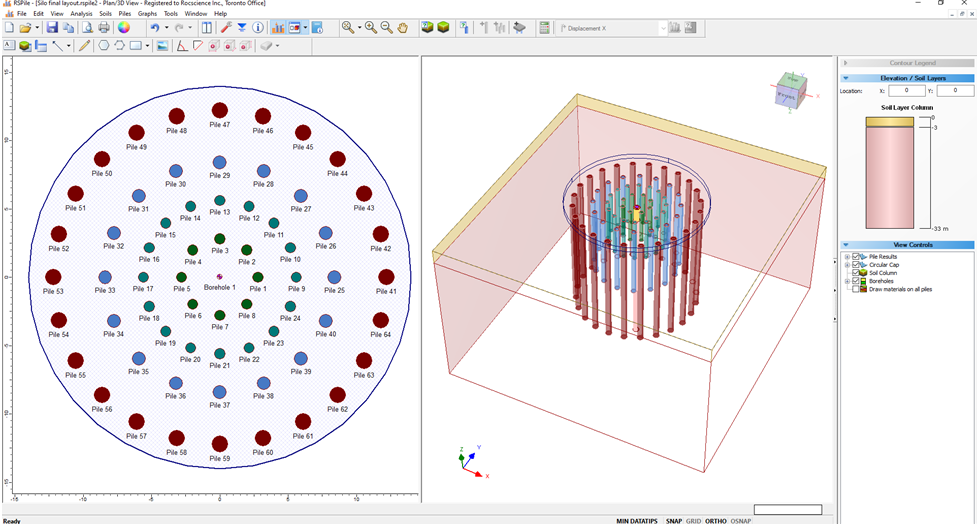
Analysis of a Circular Pile Group Supporting a Heavy Alumina Storage Silo Published on: Sept 13, 2019  Updated on: Jul 13, 2022  5 minutes read Share: By Ahmed Mufty, Ph.D.,P.Eng. Rocscience’s RSPile is a powerful tool that can be used to study the behaviour of piles in a group to obtain their required lengths and assess their load settlement relations. To demonstrate the pile design capabilities and flexibility of the program, this article presents the results of an analysis conducted on a circular pile cap with a heavy load. The pile cap was 28 m in diameter and was designed to hold a cylindrical silo 38 m in height intended for Alumina storage. The results of the structural analysis showed that the most critical silo load combination, taking into consideration all wind and earthquake load conditions, was a total vertical load of 240000 kN, and that the load could generate a turning over moment of 1100000 kN.m, with a horizontal load on the pile cap equal to about 10% of the vertical load. The ground layers at the site consisted of about 3 m of sandy gravel of high density overlaying even denser sandy gravel with cobbles and rock pieces that turned into conglomerates at a depth below the expected depth of the pile tips. A standard penetrometer test (SPT) was conducted on the site, and blow counts were recorded from two boreholes and extrapolated. Figure 1 below shows the blow counts plotted against depth. Figure 1: SPT blow count. B/30 cm Using RSPile to compute axial load, the Drilled Sand method to simulate load settlement behaviour was chosen, with the load settlement curve following the Reese Suggestion for piers drilled in sand (see the RSPile Axially Loaded Piles manual). This method depends on the ultimate unit skin friction and ultimate unit end bearing of the pile at each layer, showing that smaller diameter piles reach their ultimate capacity at less settlement than larger piles. Based on local experience and previous tests, the method by Reese and Wright (1977) was adopted to estimate the skin resistance and the end bearing, where: Fsult = 150+2(N-53) in kPa for N>53 Fbult = 57.5N limited to 4300kPa These correspond to values of 244 kPa and 444 kPa, for skin resistance for the two layers, respectively, while the ultimate end bearing was capped at 4300 kPa. These values were entered into the Axial tab of the RSPile Soil Properties dialog. In addition, Kpy values of 60 MN/m3 and 80 MN/m3 for the two layers, respectively, were entered in the Lateral tab. Based on the silo wall location, a preliminary trial layout was chosen for the piles to receive loads, with piles 1 m in diameter and 15 m in length, and a cylinder strength of 50 MPa and 0.6% reinforcement in their section along the length (see Figure 2). Figure 2: Preliminary trial layout of piles. A grouped pile analysis of the preliminary trial layout was performed, with Pile Analysis Type in the Project Settings Analysis tab set to Grouped Pile Analysis. Resulting load distributions for piles 1, 9, 25, and 41 (the piles that received the highest load) are shown in Figure 3. The accuracy limit was fixed to 0.001 and the number of iterations was limited to 200. Figure 3: Results of the preliminary trial layout analysis Results showed that the piles at the outer ring received a higher load than those at the inner rings, and that the shear force for the two inner rings was almost the same. According to the results, the piles in the layout were altered to types A, B, C, and D, as shown in Table 1. Table 1: Pile types in the revised and final pile layout. The distribution of the piles was kept unchanged, but the piles were given different diameters and lengths, based on their ring position. Shorter piles with smaller diameters were placed at the inner rings while longer piles with bigger diameters were placed at the outer rings. The revised and final pile layout in RSPile is shown in Figure 4. Figure 4: Revised and final layout of piles. In order to calculate the load settlement for the different pile types, several analysis runs were performed on each pile type with different load levels. To accomplish this, another RSPile model was created for the same pile types in which the pile types were added as patterns, and the piles were then ungrouped and given different loads until an excessive settlement was reached. The model for this load settlement analysis can be seen in Figure 5. Figure 5: Analysis of the four pile types for different vertical loads. As can be seen, nine load steps were used to calculate the load settlement curves, and the last three piles at the bottom were added to smoothen the curves further by adding intermediate points. The resulting load settlement curves for each pile type are displayed in Figure 6, Figure 7, Figure 8, and Figure 9. Figure 6: Load settlement curve – Pile type A. Figure 7: Load settlement curve – Pile type B. Figure 8: Load settlement curve – Pile type C. Figure 9: Load settlement curve – Pile type D. The analysis conducted on the final pile layout resulted in actions and displacements on the four piles: 1, 9, 25, and 41, as shown in Figure 10. Figure 10: Results of the final pile layout analysis. As can be seen, loads on the heads of the four piles were 2583 kN, 3658 kN, 6430 kN, and 11148 kN, with a factor of safety of 2.58, 2.38, 2.95, and 3.37 for pile types A, B, C, and D, respectively.

Pile Capacity Table Generator – A new feature in RSPile

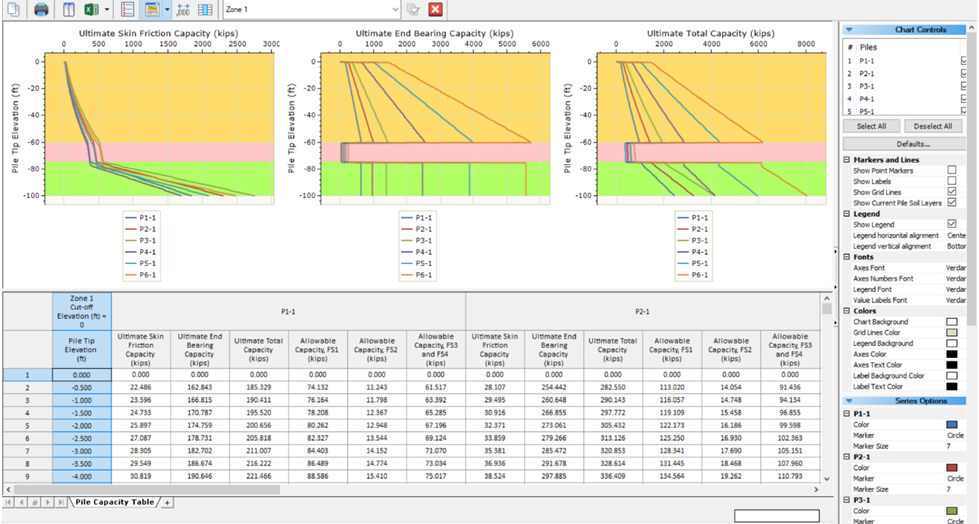
Pile Capacity Table Generator – A new feature in RSPile Published on: Jun 23, 2022  Updated on: Nov 09, 2023  3 minutes read Share: RSPile, our FEM Pile Analysis program is one of the most comprehensive Pile Analysis software in the industry today. The program is designed to handle analyses that include Axially Loaded Piles, Laterally Loaded Piles, Grouped Piles, Driven Piles, and Bored Piles. Pile Capacity Generator Table To further the capabilities of the program as part of our continuous software development model, we have recently added the Pile Capacity Table Generator, which gives you an option to generate a table for proposed Bored piles capacity with depth. This kind of table is widely used by site investigation and geotechnical firms to prepare a ready guide for the structural engineers to choose their piles’ distribution in their preliminary analysis of the superstructure and the foundations. Capacity Table Generator can be selected under the Capacity Calculations tab in the Project Settings dialogue Usually, at the beginning of a project, it is difficult to know exactly how much load will be transferred to the piles and how many load combinations and load cases are present. A preliminary estimate for the allowable capacity of several proposed piles will be very useful to start the analysis. After the first run of the structural analysis program (ETABS, SAFE, Ansys, STAAD Pro, etc.), the loads on the piles are found usually assuming them as hinges or fixities at the foundation retaining supports. With these loads, the first estimate of pile sizes and lengths may be chosen from such a table to start a further investigation and runs for the program with new supports that represent the piles as springs (whether linear or non-linear) to optimize the choice of the piles. The pile capacity table generator not only provides you with the ultimate skin friction and ultimate tip resistance but also includes the tool that allows you to apply different factors of safety to determine the allowable carrying capacity of the piles as per your convenience. Graphical representation of the variation of ultimate and allowable capacities with depth helps the designer to visualize where the changes are potential and to choose suitable depths to end the piles at. You can choose to limit or free the average sectional stress. A sample Pile Capacity Generator Table The pile capacity table generator allows you to divide the project area into sub-areas or Zones that will be defined for pile capacity calculations differently with each zone having its own soil layering and ground surface based on interpolating between the boreholes. A unified cut-off level may be assigned for each zone and you can view the project zoning in 2D layout and 3D view. Pile designers and geotechnical investigation firms will be able to optimize the project zones for cost minimization and adopt elevations closer to foundation levels. With the Pile Capacity Generator Table, we aim to ease the everyday life of practicing engineers and we will continue to add further results in the upcoming releases to ensure this capacity table is your bible for piles choice. Tutorial To try your hand at analyzing various bored pile types across different zones of the site and generate capacity tables and graphs in RSPile, follow our Pile Capacity Table Generator Tutorial.

Integration Meets Innovation with Slide2 & RSPile

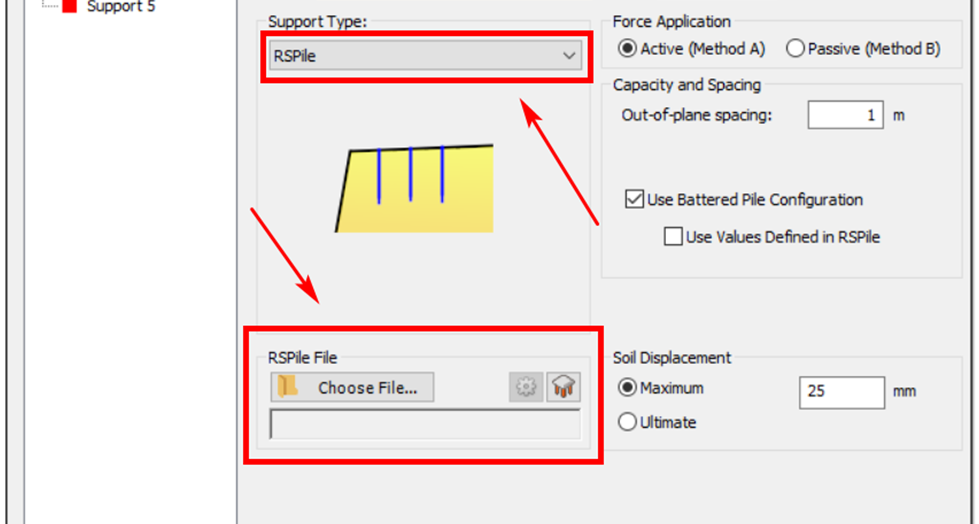
Integration Meets Innovation with Slide2 & RSPile Published on: Apr 13, 2020  Updated on: Nov 09, 2023  3 minutes read Share: When it comes to designing supports for your 2D slope stability analysis, few programs are as comprehensive or user friendly as Rocscience’s Slide2. One of the best examples of this is the seamless integration of Slide2 with the general pile analysis software RSPile. Unlike other geotechnical software suites, the data from Rocscience’s various 2D and 3D slope stability programs (for example: Slide3 and RS3) can be easily imported from one program to another. With RSPile and Slide2 in particular, the programs are built to work in conjunction with each other. With these two programs, a user can easily install a pile support in Slide2, define the pile model in RSPile, and compute the pile resistance functions against sliding to be used for their slope stability analysis. How to import an RSPile file into Slide2 The installation of piles is one of the most common methods of slope stabilization in the industry. This makes the general pile analysis software RSPile a particularly useful addition to your slope stability suite. The RSPile program allows users to design and analyze numerous types of piles to meet the needs of their geotechnical project including driven piles, axial and laterally loaded piles, and grouped piles. In the case of slope stability analyses, RSPile automatically calculates the pile resistance by allowing the user to specify the range of sliding depths examined in the analysis and producing the corresponding pile resistance functions. These pile resistance functions produced in RSPile are easily imported into the Slide2 program. Simply open the Define Support Properties dialog and select RSPile as your support type. From here you can launch RSPile and import the RSPile file directly into Slide2. Slide2 – Define Support Properties dialog With one RSPile model file a user can define the soil and pile properties for multiple piles of various embedment lengths and soil layer configurations. Slide2 – Model with pile support For each intersected slip surface to a pile, Slide2 will use linear interpolation to determine the appropriate resultant pile resistance and compute the factor of safety. Make your suite complete with RSPile This past month RSPile has released several exciting new features including: New loading feature that allows loads to be applied to a specific point along the length of the pile, instead of only at the top. Linearly distributed traction loads can now be applied to piles by specifying depths and load values at the top and bottom. Improved design tools for reinforced and concrete piles allowing users to specify casing and reinforcement pattern lengths.

Improved Analysis of Reinforced Concrete Piles in RSPile

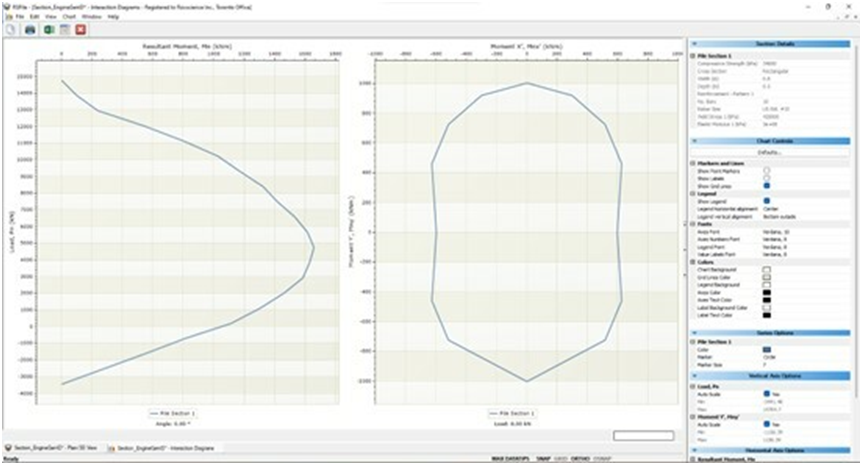
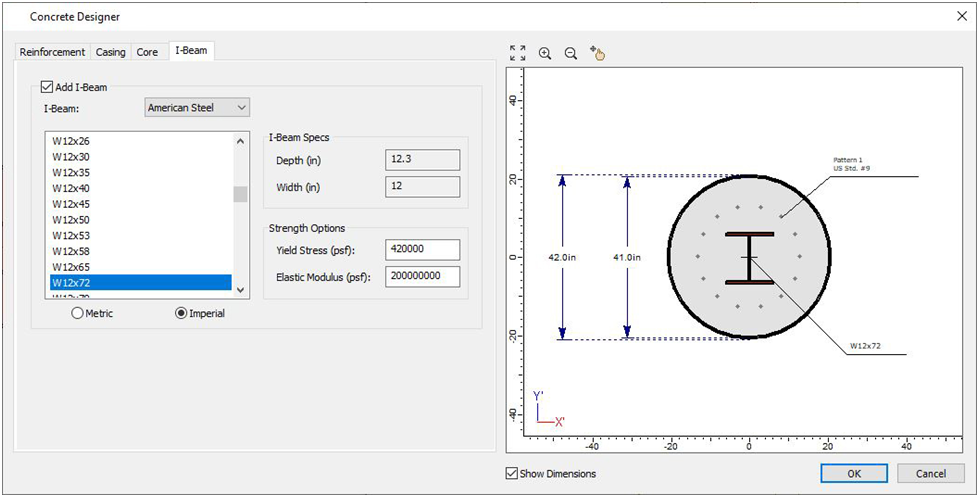
Improved Analysis of Reinforced Concrete Piles in RSPile Improved Analysis of Reinforced Concrete Piles in RSPile Published on: Oct 26, 2022  Updated on: Nov 09, 2023  9 minutes read Share: Authors: Ahmed Mufty, Senior Geomechanics Specialist at Rocscience Julien Chaperon, Geotechnical Project Manager at Rocscience Introduction This article depicts how the pile analysis under lateral loading, or couples is improved in RSPile by updating the pile flexural stiffness during the solution in cases of piles with combined flexural and axial stresses. This is raised because of the bending (flexural) stiffness of the pile varies with the level of cracking and the applied axial load. In previous versions and in most of software the bending stiffness-moment relation is a single curve constructed in the beginning of the analysis and never updated or varied along the pile length. Usually, that curve is based on the loading of the pile head while pile load may change at other depths as well, which may have significant effect on the flexural stiffness. In the latest version of RSPile release 3.014, this issue is addressed and solved. The results of the pile analysis with updated bending stiffness clearly varies with depth during the analysis. An example is solved in this article to compare the results between single and variable moment-curvature curves (bending stiffness) with depth. Theoretical background In piles with reinforced concrete sections, one of the parameters for the analysis of piles under lateral loading or bending moments is the bending (flexural) stiffness, effective EI. In ACI 318–2019, and similar codes around the world, the effective EI may be approximated by the concrete modulus of elasticity, Ec , multiplied by an effective moment of inertia Ie , a value falling between the cracked section moment of inertia, Icr , and the gross moment of inertia, Ig. Most of the pile analysis methods depend on a constant bending stiffness throughout the analysis. For LRFD analysis half of the gross moment of inertia will be acceptable and for the serviceability levels a gross moment of inertia may be an adequate value to use. With the spread of computer software for pile analysis, the bending stiffness is not constant anymore in the analysis and better value for EI is estimated during the iterations of the solution of the beam-column differential equation (by FEM or FDM methods) relating it to the last calculated curvature of the beam at that step of iteration φi where i refers to the iteration. The easiest method to calculate an updated bending stiffness for a specific point at the beam in an iteration step, (EI)i , is the relation, (EI)i= Mi/φi Derivation for this relation may be found in classical textbooks of strength of materials, see for example Higdon et al. (1978). The moment curvature curve is prepared from the beginning to pick the corresponding EI at any moment-curvature level. This helps getting better results for the response of the pile to the applied loads. The bending stiffness is highly dependent on the applied axial load at the section and the axial load varies with depth due to the soil resistance around the pile, i.e., the skin friction. The skin friction decreases the axial load with depth (or increases it in the case of negative skin friction) and it may also vary due to additional external loads applied on the pile at different depths. In traditional pile analysis the bending stiffness is taken constant along the depth which is true for elastic sections. Engineers in hand calculations or simple spread sheets assume the reinforced concrete pile as an elastic section. Meanwhile, most of the software programs the relation between bending stiffness and the bending moment in reinforced concrete sections is assumed unchanged and a single M-φ curve is used for the whole length of the pile (just like a column in a structural frame). Reese and Van Impe (2011) stated that “the errors that are involved in using the approximation where there is a change in the bending stiffness along the length of a pile are thought to be small but must be investigated as necessary”. Nevertheless, the error increases with new external loads added to the pile through the depth and in several other cases such as changes in section dimensions or materials (e.g. reinforcement ratio). This error is overcome in the recent version of RSPile 3.014. This is accomplished by generating a series of moment-curvature curves based on the range of internal axial force experienced by the pile. The bending stiffness of the reinforced concrete pile is then obtained as a function of both internal axial force and curvature. Fig.1 depicts the difference between the use of a single M-φ relation and multiple ones in the modeling. Fig.1, Representation of axial force change along the pile elements and corresponding moment-curvature curves. The single relation used is replaced with variable curves with depth. Example problem Pile section and soil model A pile with a rectangular reinforced concrete section of 500 mm depth and 800 mm width with 34 MPa concrete strength and reinforced with 10 #10 bars placed peripherally at 100mm cover. The pile is analyzed using RSPile under a lateral load in the long side direction of 150 kN applied at the pile head investigating the response applying different vertical downward loads at the top of the pile, 100 kN, 500 kN and 1000 kN. The section details are shown in the section designer of RSPile in Fig.2. Pile length is taken as 20 m fully embedded in soil. To control soil parameters effects, the soil is assumed elastic with a constant modulus of lateral subgrade reaction of 1000 kN/m3 and a skin frictional spring of 10000 kN/m3 while the end bearing stiffness is set to zero to govern the axial load distribution by the skin friction only. Fig.2, Rectangular reinforced section shown in concrete designer dialog of RSPile. Section structural capacity With the introduction of Interaction Diagrams in RSPile, users can now estimate the structural capacity of their concrete section in a single click. Fig.3 shows interaction diagram for the short column (pile), the nominal axial load capacity, Pn plotted against the nominal bending moment capacity Mn for a load applied at an angle α of 0o taken counterclockwise from x’ axis. At the right side the Mnx’-Mny’ plot is

Structural Solutions by RS2 – Problem of Stacked Beams

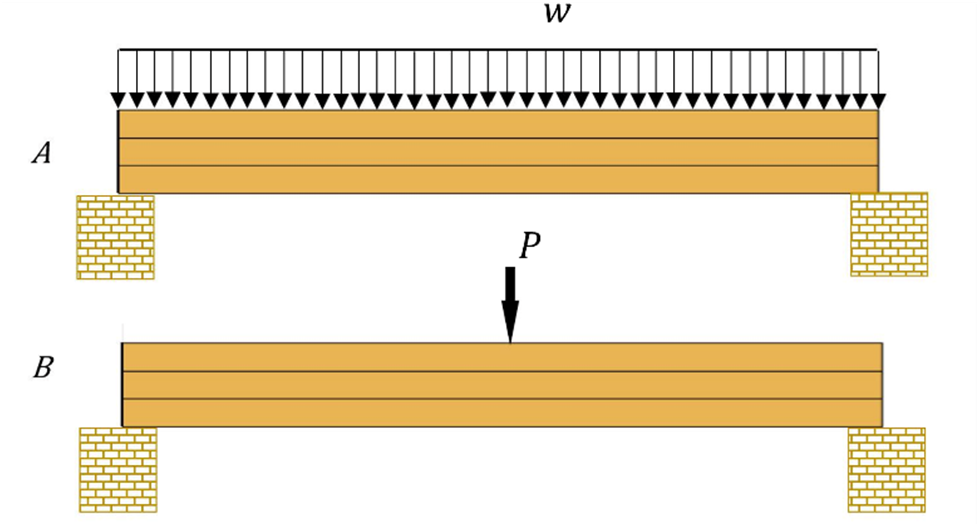
Structural Solutions by RS2 – Problem of Stacked Beams Published on: Feb 01, 2024  Updated on: Feb 28, 2024  7 minutes read Share: Author: Ahmed Mufty, Senior Geomechanics Specialist at Rocscience Introduction This article is intended to show the power of RS2 in solving a complicated structural problem. The problem chosen is the well-known stacked beams problem. It is known that if you stack identical simply supported beams made of elastic material under any distributed loading the load effect will be distributed equally to each of the stacked beams. For a simply supported beam subject to uniformly distributed load or concentrated load, the bending moment at mid-span will respectively be, M = wL2/8 M = PL/4 where, w = uniformly distributed load, units of F/L P = concentrated load at mid-span, units of F L = length of beam, units of L What happens if you have three smooth beams stacked together? For example, if you have 3 stacked beams such as the ones shown in Fig.1(a) or Fig.1(b) the resulting bending moment at the middle of the beams will be one-third of the above values. This is based on the theory of beams. But if you analyze the problem as a continuum the results will be different as the concentrated load gets distributed along the depth of the beams. The original problem A beam was subject once to uniformly distributed load w (case A) and another to a concentrated load P (case B). The load P is half the resultant of the distributed load w such that they both produce the same bending moment at mid-span, i.e., P = wL/2. A laborer got afraid of the beam failing to hold the loads. He added two stacked beams on the original beam, all symmetrical. The question is in which case will the bottom beam get less bending moment? Fig.1, stacked beams under uniformly distributed load and a concentrated load. Answer and reason: Eventually, following the beam theory, the bending moment at each beam will be equal to one-third of the original moment. Here comes the surprise: As the beam has a depth continuum theory will distribute the concentrated load and turn it from a point load at the top beam to a distributed load at the bottom beam. The answer is “Case B”. In case A, the load will be transmitted to the lower beams as is so keep the reduction in the bending moment uniform. In case B, the concentrated load gets distributed to a length that increases in the following beams and hence will decrease the moments. The distribution takes place due to the thickness of the beam (a beam with no thickness cannot distribute by thickness) and due to the subsurface reaction of the following beam (like a subgrade reaction) which arises from “springs” that can be assumed corresponding to the varying bending stiffness of the beam deflecting below the above beam. Note that, the answer is based on no friction or connection between the beams. Each beam acts individually but of course, not independently. Proof by an RS2 Finite Element Model Using the 2D FEM program, RS2, a software product of Rocscience Inc., the three beams may be modeled easily. Nevertheless, some considerations shall be taken while assigning properties to materials and interfaces. In the following, a numerical example is introduced. To simulate a model, first, dimensions and materials shall be chosen reasonably. The beam’s dimensions are taken as 22 ft in length 1 ft in width, and 0.5 ft in thickness. The material is chosen with a smooth surface (no friction material). A modulus of elasticity of 2E8 psf and a yield strength of 2E6 psf with a Poisson’s ratio of 0.25 are decided. These are given as elastic plastic material with a friction angle of zero and a cohesion of 1E6 psf in a Mohr-Coulomb model. Limit for tensile strength may be specified as well as 2E6 psf. No body forces are applied, i.e., the beams are weightless (the answer, being case B, will not get affected by self-weight addition as it is the same in both cases). The beams are stacked on two supports as shown in Fig. 2 below with a length of 20 ft between supports. The reason for not taking the supports at the ends is to show symmetric stress concentration near the supports. To separate the beams from each other, joints shall be used in RS2. This provides an interface layer in FEA. The joints shall have no shear stiffness, a very low value of 1E-12 psf/ft is used, and a normal stiffness close to the modulus of the material is used, 2E8 psf/ft. While the joints must fail in holding tension, the tensile strength of the joint is eliminated, and the shear strength is not effective as the shear stiffness is very low already. The joints are “open-ended” and have two rows of nodes. Fig.2, The beams, and the joints in RS2 Geometry. And because of numerical nature of the analysis and no lateral loads are applied, it is better to replace the hinge by rollers at the same point and on the side centers of the beams as shown in Fig.3. Fig.3, Replacing the hinge with rollers and showing the loads. Loads In Case A, a uniformly distributed load, UDL, w = 100 lb/ft is chosen, to give a bending moment at midspan of a single beam of 5000 lb. ft, and in turn, causes a tensile stress of 120000 psf as Mc/I. Hence, the corresponding concentrated load that gives similar moment and stress is 1000 lb. When the UDL is applied to the stacked three beams the bending moment is divided by the three beams equally and the resulting tensile stress at the bottom will be 40000 psf. If the results show a tensile stress at the bottom less than 40000 psf then Case B is the answer, and the proof is done. The loads are shown in Fig.3. Meshing The mesh setup in RS2 is chosen as graded mesh of 6-noded triangular elements with 400 external nodes. Part

How Can Structural Engineers Benefit From RSPile?

Published on: May 10, 2023  Updated on: Mar 06, 2024  3 minutes read Share: Author: Ahmed Mufty, Senior Geomechanics Specialist at Rocscience RSPile has come a long way since its inception as a simple program called “Driven.” Today, it stands as a sophisticated pile analysis software specifically designed to cater to the needs of pile designers and structural engineers intending to check sections of compression members. With each new release, we strive to enhance its capabilities, making it an indispensable tool for pile designers in their everyday work. Comprehensive Pile Analysis Features RSPile encompasses a wide range of powerful features for analyzing both individual piles and pile groups. It provides capacity calculations for driven and bored piles, a capacity table generator, individual and multi-pile analysis, as well as group analysis. Additionally, RSPile offers a host of routines and tools that streamline various aspects of pile design. Empowering structural design, we are thrilled to announce that RSPile now incorporates several structural design features, making it an invaluable asset for pile designers and structural engineers alike. With these new capabilities, RSPile enables users to perform structural design of reinforced concrete section with more tools. Reinforced Concrete Sections RSPile introduces a dedicated section detailing design section tab for reinforced concrete circular and rectangular sections. This interactive and user-friendly interface allows you to design your sections efficiently. Flexible Pile Construction and Analysis The pile type editor in RSPile empowers you to construct your pile with multiple sections and customize reinforcement distributions effortlessly. This flexibility enables you to model and analyze piles accurately according to your project requirements. Interaction diagrams Investigating and constructing interaction diagrams is easy. The software offers a robust platform for generating factored and unfactored diagrams, encompassing axial load and biaxial bending. Concrete stress strain curve models such as Modified Hognestad and Whitney block methods are available and users can set design standard factor for M and P or use ACI 318 factors. Moreover, you can visualize these diagrams in a 3D format, gaining comprehensive insights into the structural behavior of the pile elements.   Capacity Ratio Calculation Ensuring the structural capacity of your sections is of paramount importance. RSPile now features a capacity ratio calculation tool that checks moment-load points against the factored interaction surface. By identifying red cells for the locations that fall outside this surface, the software highlights sections that require redesigning, enabling you to maintain structural integrity.

The Latest Features in RSPile

Published on: Aug 17, 2021  Updated on: Feb 24, 2023  9 minutes read Share: RSPile is a powerful 3D pile analysis program designed to help you overcome your most challenging projects. RSPile can be used for foundations and slope support. Stay up to date with the latest features and integrations that you can incorporate into your geotechnical projects. February 2023 Enhanced Interaction Diagrams and Structural Capacity Ratio RSPile is continuously and rapidly developing, becoming an everyday tool for piling and geotechnical engineers. With three main modes of analysis: pile load-carrying mode, individual pile analysis (single piles or patterns of piles), and group analysis mode, a wide variety of piles may be analyzed for different types of loading. You can determine the capacity of driven piles, bored piles, bored piles with enlarged base or multisectional piles. A set of sensitivity analysis choices are also available such as length analysis, pushover analysis, pile stiffness, etc. Many T-z and Q-z curves for different soil types and many methods for skin resistance and tip resistance are built in, though you can define your own curves or resistance values. RSPile has the capacity to design a reinforced concrete section for bored or prestressed piles and to build up your pile with multiple sections with varied size or material. In recent developments, RSPile has expanded to start providing structural options including sections with moment capacity, and bored piles with casing, core or adding structural steel sections. In the latest release, two major structural options for bored piles are introduced. Although the interaction diagram for reinforced concrete sections, unfactored M-P curves for biaxial bending vs. axial load was a feature that was developed in the previous release, the new release will have enhanced computations, faster execution time using an efficient optimization method, and an additional stress strain relation (ACI 318) was added to the interaction diagram construction process. Also, material factors are allowed now with single user choice factor or ACI 318-19 factors. RSPile now has a tool to compute many interaction diagrams for multiple sections at the same time and you can change the angle of load application point or have Mnx-Mny plots at different axial load levels. Both factored and unfactored plots can be shown at the same time and in the same plot for comparison. Another valuable feature being introduced is the determination of the structural capacity ratio for all reinforced concrete sections throughout the length of the pile. This is given for now as a graph in pile results when subject to loading. So, it compares the structural biaxial moment and axial load with the available capacity and hence, the failure or unacceptable section design may be detected easily. Imagine you can do that for hundreds of piles in one shot. So, if the capacity ratio is less than unity then the pile is safe. If exceeds unity, then you should revisit the section design at the failure levels. You can see in the figures below how interaction diagrams will look like (you may change the number of points in the plot for smoother curves). June 2022 Pile Capacity Generator Table To further the capabilities of the program as part of our continuous software development model, we have recently added the Pile Capacity Table Generator, which gives you the option to generate a table for proposed Bored piles capacity with depth. This kind of table is widely used by site investigation and geotechnical firms to prepare a ready guide for the structural engineers to choose their piles’ distribution in their preliminary analysis of the superstructure and the foundations. Capacity Table Generator can be selected under the Capacity Calculations tab in the Project Settings dialogue Usually, at the beginning of a project, it is difficult to know exactly how much load will be transferred to the piles and how many load combinations and load cases are present. A preliminary estimate for the allowable capacity of several proposed piles will be very useful to start the analysis. After the first run of the structural analysis program (ETABS, SAFE, Ansys, STAAD Pro, etc.), the loads on the piles are found usually assuming them as hinges or fixities at the foundation retaining supports. With these loads, the first estimate of pile sizes and lengths may be chosen from such a table to start a further investigation and runs for the program with new supports that represent the piles as springs (whether linear or non-linear) to optimize the choice of the piles. The pile capacity table generator not only provides you with the ultimate skin friction and ultimate tip resistance but also includes the tool that allows you to apply different factors of safety to determine the allowable carrying capacity of the piles as per your convenience. Graphical representation of the variation of ultimate and allowable capacities with depth helps the designer to visualize where the changes are potential and to choose suitable depths to end the piles at. You can choose to limit or free the average sectional stress. A sample Pile Capacity Generator Table The pile capacity table generator allows you to divide the project area into sub-areas or Zones that will be defined for pile capacity calculations differently with each zone having its own soil layering and ground surface based on interpolating between the boreholes. A unified cut-off level may be assigned for each zone and you can view the project zoning in 2D layout and 3D view. Pile designers and geotechnical investigation firms will be able to optimize the project zones for cost minimization and adopt elevations closer to foundation levels. With the Pile Capacity Generator Table, we aim to ease the everyday life of practicing engineers and we will continue to add further results in the upcoming releases to ensure this capacity table is your bible for piles choice. Tutorial To try your hand at analyzing various bored pile types across different zones of the site and generate capacity tables and graphs in RSPile, follow our Pile Capacity Table Generator Tutorial. How can I try out